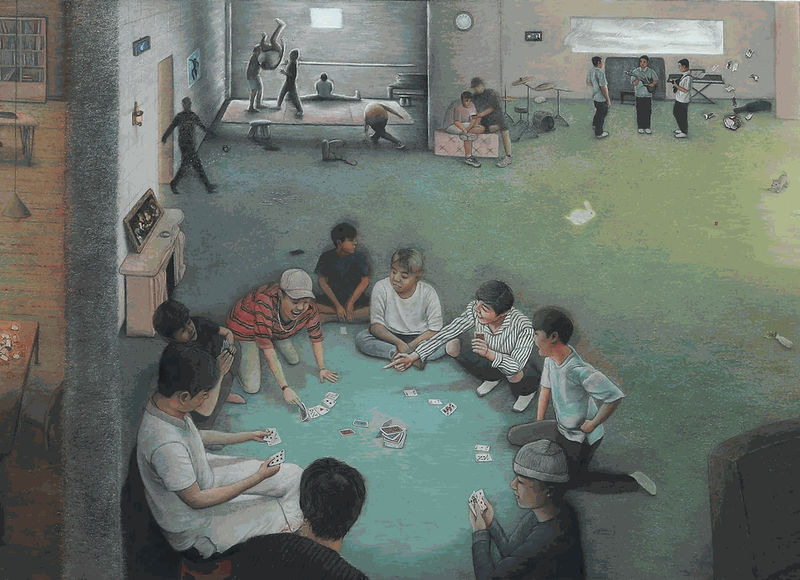
Lessons through Dusk and Dawn, 2023, pigment on washi, 117 x 285 cm
Zearo’s practice is rooted in an autobiographical perspective shaped by his Southeast Asian heritage. Exploring longing, desire, memory, and masculinity, his works trace the shifting dimensions of queer relationships across psychological spaces that oscillate between private interiors and broader social realms.
In intimate scenes, male figures often appear at domestic thresholds — staircases, windows, doorways — poised between revelation and concealment. These recurring figures navigate shifting states of being, exploring the psychological terrain of self-confrontation and the lingering presence of others. Fetishised and everyday objects recur as traces, gaining symbolic weight as markers of intimacy, loss, and desire. By contrast, his group compositions capture the subtle tensions, exchanges, and connections that arise within shared spaces, revealing the rhythms and relationships of bodies in relation to one another. Together, these approaches open a spectrum of queer experience, spanning the private and the communal, the personal and the politically resonant.
His spatial imagination draws on medieval compositional structures and the drifting perspectives of Chinese handscrolls.The interiors function as both architectural containers and psychological landscapes, where stories unfold through fractured yet continuous narratives.